
Reviewed · CANAL & HARBOUR BOAT TRIPS
Aarhus: Harbour Cruises with local guide
Few places teach a city like water does. This guided Aarhus Harbour cruise turns the waterfront into a live lesson, with local guide stories that link fairy tales, Vikings, and modern Danish design.
I especially like the way the narration ties specific sights to the bigger picture, from Hack Kampmann’s Customs House to the futuristic shapes of Aarhus Ø. And the boat setup is practical, with a cozy feel, a bar for hot and cold beverages plus snacks, and child activities that help families stay engaged.
One consideration: you only get about 75 minutes, so it is perfect for getting an overview fast, but it is not a long, in-depth walk through each neighborhood.
In This Review
- Key things you will remember from the Aarhus Harbour cruise
- From Sirene to Sirene, the waterfront starts telling stories fast
- The cozy boat, the bar, and why comfort affects the quality of a harbor cruise
- The harbour route and what the guide points out at each key stop
- Endless Connection fountain, where kids play and themes begin
- Sirene sculpture, modern art with a Danish personality
- The old Customs House, Hack Kampmann and fairy-tale architecture
- DOKK1 and the giant bell tradition
- Vikings, Aros, and smoke signals from Mols Bjerge
- The old tugboat Jacob and why this ship has international stakes
- Wall art and global references, from UN goals to a miner from Novosibirsk
- Architecture waves, Bjarke Ingels, bathhouses, Aarhus shape, and the Campanile
- Aarhus Ø, the city on the sea, and bold forms like Iceberg and Lighthouse
- Brave bathers since 1933, plus the sailing center
- Wooden Ship Harbour, 70 historic ships, and living cultural heritage
- Marina, Klintegården, and Ove Christensen’s modernist ideas
- Fishing boats and houseboats, real use instead of display
- Who this cruise is best for, and who might want something else
- The value question: what $25 buys you in real experience time
- Booking mindset: when to choose this and when not to
- Should you book the Aarhus Harbour cruise?
- FAQ
- How long is the Aarhus Harbour cruise?
- Where do I meet the group?
- How much does the tour cost?
- What languages are the guides?
- Is there a bar or snacks on board?
- Is the cruise wheelchair friendly?
- Is the tour suitable for children?
- What can the tour include in terms of sights and stories?
- Is free cancellation available?
Key things you will remember from the Aarhus Harbour cruise
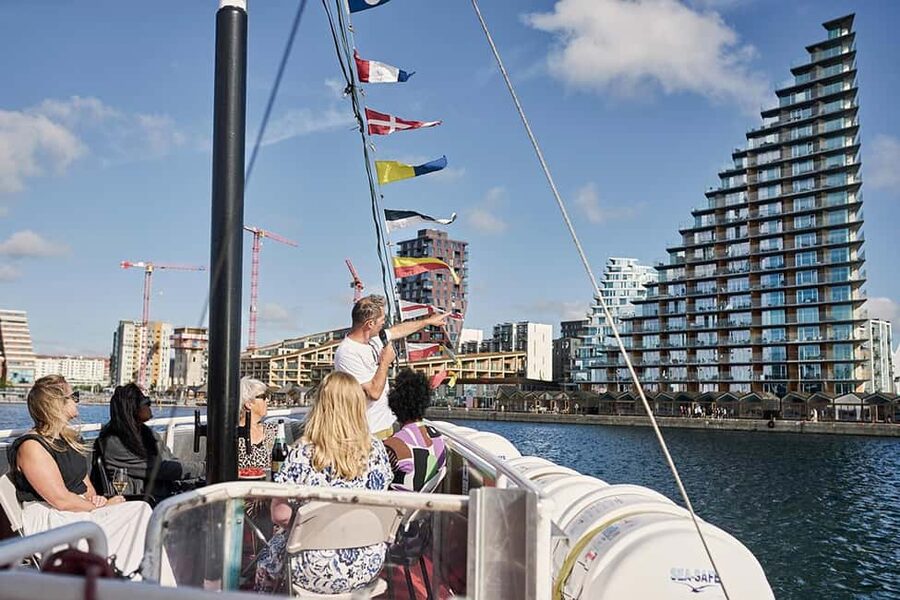
- You pass major landmarks while the guide explains the meaning behind the design
- Kids can get hands-on, including steering time, plus an end-of-tour keepsake in some cases
- The route is built around recognizable waterfront moments like Sirene and Endless Connection
- You hear big-name architectural details, including the Campanile and the copper-colored tower concept
- You cruise by the Wooden Ship Harbour, home to historic ships as living cultural heritage
- A bar, snacks, and wheelchair-friendly access keep the trip comfortable for different needs
From Sirene to Sirene, the waterfront starts telling stories fast
Aarhus Harbour is one of those places where you can feel the city changing in real time. On this 1 hour and 15 minute cruise, you do not just look at buildings, you learn why they are there. The adventure starts even before the boat leaves, right at the fountain area by the Endless Connection, where the ship is located behind the fountain.
You will be guided in English or German (and Danish is also offered). That matters because the best parts of the tour are the details the guide pulls together, not just the view. Instead of a generic sightseeing loop, you get a connected storyline that moves across centuries.
I also like that this is not a quiet, stiff tour. From what families experience onboard, the trip includes genuine moments for kids, including the chance to take part during the cruise. It makes the harbor feel less like a background set and more like something your group is participating in.
More time on the canals and harbour:


The cozy boat, the bar, and why comfort affects the quality of a harbor cruise
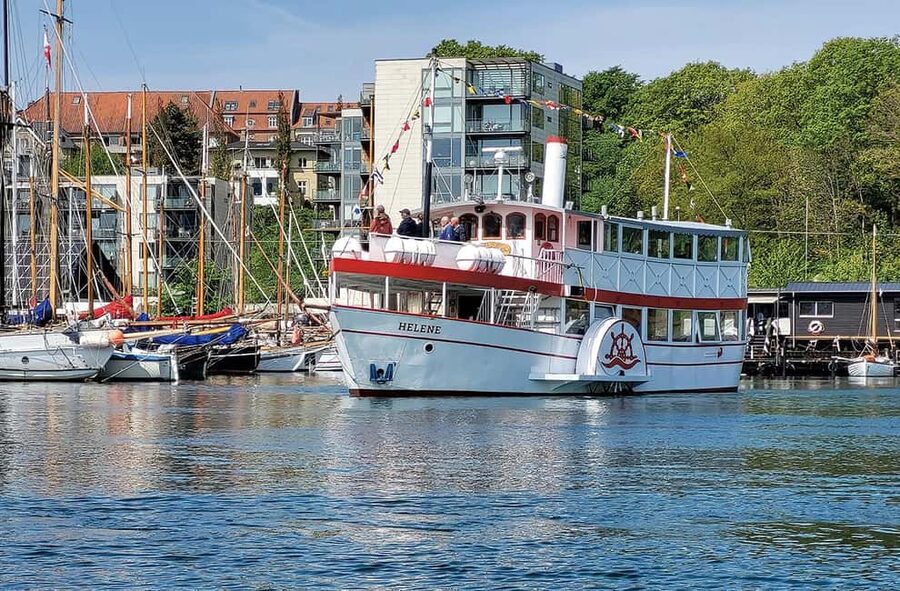
A harbour cruise sounds simple, but your experience depends on comfort. This one uses a comfortable, cozy ship with the kind of conveniences you actually appreciate on a scheduled trip: a bar with hot and cold drinks plus snacks, and onboard facilities designed to be easier for visitors with mobility needs.
Wheelchair access is part of the setup, and there are wheelchair-friendly toilets. That is not a throwaway line. For many travelers, the difference between “we can go” and “we have to skip it” is access and restroom practicality, especially on tours that last just over an hour.
You will also feel the timing advantage. At 75 minutes, the tour is long enough for the guide to cover multiple highlights and short enough that most people can handle it without a full day commitment.
The harbour route and what the guide points out at each key stop
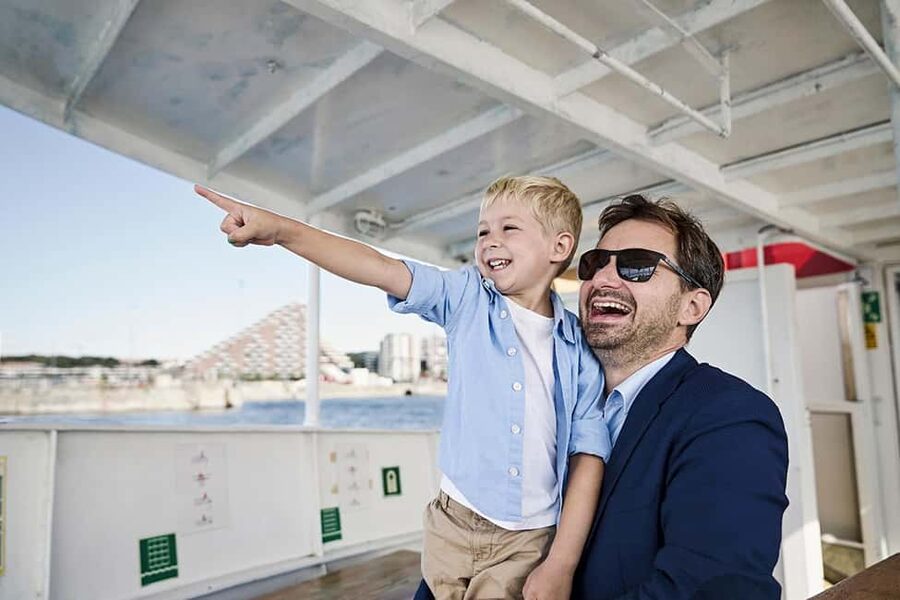
The core of the experience is the guided loop around Aarhus Harbour, with the narration built around a series of recognizable points. Here is how the story comes together as you move along.
Endless Connection fountain, where kids play and themes begin
Right at the start you are near the Endless Connection fountain. In summer, the kids play in and around the fountain’s labyrinth. It is a small detail, but it sets the tone: this harbor is not frozen in time, it is used.
From there, the guide uses the immediate surroundings to transition into bigger themes, like how Danish design blends public art, community behavior, and storytelling into everyday spaces.
Even more Things to Do in Aarhus
- Aarhus Walking Tour: From Viking Village to Metropolis
★ 4.8 · 122 reviews - Street Art and Rooftops of Aarhus, Denmark
★ 5.0 · 62 reviews - The Ancient Viking Stronghold of Aros: A Self-Guided Audio Tour in Aarhus
★ 4.0 · 36 reviews
Sirene sculpture, modern art with a Danish personality
Next to the ship area, you will spot Sirene, a sculpture created by Prince Henrik of Denmark. It is described as round and organic, like much of his art. I like this stop because it is easy to understand just by looking, and it gives the guide a way to discuss Denmark’s approach to public art, not just famous buildings.
A practical tip for your photos: aim to shoot this early. Light changes quickly over water, and you do not want to save the most uniquely shaped sculpture for later when you are dealing with glare.
The old Customs House, Hack Kampmann and fairy-tale architecture
The old Customs House, built in 1897 by Aarhus architect Hack Kampmann, is another anchor point. The guide connects Kampmann’s love of fairy tales and mythology to the architecture you are seeing.
This is where the tour starts doing something useful: it explains that design choices are rarely random. When you hear why something looks a certain way, it stops being “a building” and becomes part of a cultural pattern. Even if you are not an architecture buff, this kind of context makes the harbor feel smarter and more human.
DOKK1 and the giant bell tradition
DOKK1 appears next, home to the main library and the city’s citizen service. In front of it is a giant bell, and it is customary to let it ring when a new Aarhus resident is born.
That tradition is a good example of why a guide is worth paying for here. A library by itself is “a stop.” A library with a bell ritual tied to residents is a story about belonging, civic life, and community rhythms.
If your group loves local customs, this is one of the most memorable moments because it is specific. You hear a practice, not just a fact.
Vikings, Aros, and smoke signals from Mols Bjerge
Then the narrative goes back to the Viking Age, when Aarhus was called Aros, described as the city at the mouth of the river.
You also hear about Aros in action during conflict, with smoke signals flaring from Mols Bjerge, followed by people grabbing weapons and rowing into battle. The guide basically turns geography into momentum. You begin to understand the harbor as a strategic crossroads, not just a pretty inlet.
This kind of storytelling is especially good for first-time visitors because it helps you read the waterfront the way locals might: as a place shaped by movement, trade, defense, and work.
The old tugboat Jacob and why this ship has international stakes
One of the standout points is the old tugboat Jacob. The interesting twist is that it is not presented only as local history. It was built in Texas in 1943 and participated in D-Day during the Normandy landings.
That is a wild connection for a harbor cruise, and it makes the entire tour feel bigger than Denmark. It is also a reminder that cities like Aarhus have ties that reach far beyond their shorelines.
Wall art and global references, from UN goals to a miner from Novosibirsk
As you continue, you pass giant murals linked to big ideas. You will hear about the UN Sustainable Development Goals and a piece called A Miner from Novosibirsk.
This is another place where the guide’s role matters. If you just see murals from the water, they can look like decoration. With context, they become part of Denmark’s relationship to the world, expressed through public art.
Architecture waves, Bjarke Ingels, bathhouses, Aarhus shape, and the Campanile
Next comes a series of modern architecture highlights, including references to the architect Bjarke Ingels. You will hear about bathhouses, Aarhus, and the Campanile.
- You pass small summer homes of 21 sqm, described with a price of DKK 2.8 million each.
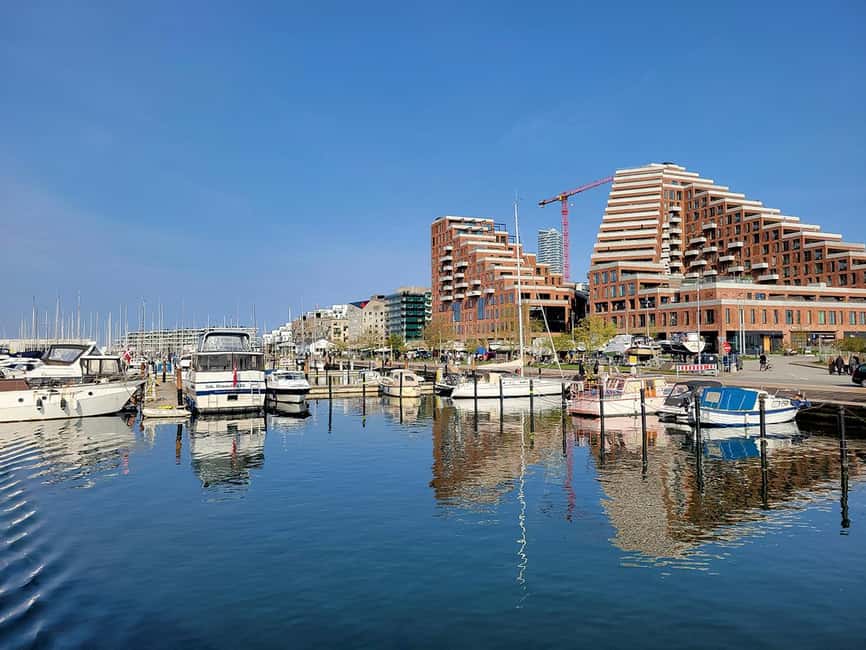
- The building behind them, named Aarhus, is shaped like two A’s and contains 250 apartments, each with terraces or roof gardens.
- The Campanile is described as a clock tower with 75 apartments, and its dial is larger than Big Ben’s. It is covered in copper, which changes color over time to an iridescent green.
I like this part because it is where the tour becomes a crash course in how modern Denmark thinks about living spaces. These are not just show buildings. They are housing, timekeeping, and public identity wrapped into one.
Aarhus Ø, the city on the sea, and bold forms like Iceberg and Lighthouse
Then you shift to Aarhus Ø, described as the city on the sea. This area is known for spectacular architecture, and the guide points out structures with names that make them easy to remember.
- The Iceberg has 210 apartments and is shaped like an iceberg.
- Another landmark is the Lighthouse, Denmark’s tallest building, at 142 meters high.
If your travel style is “I want the big shapes without doing five separate neighborhoods,” this is a great segment. You see the signature forms and get enough explanation to place them in context.
Brave bathers since 1933, plus the sailing center
You also hear about brave bathing history dating back to 1933, when men and women were allowed to bathe together, causing an outcry at the time.
After that, the Aarhus International Sailing Centre appears as another architecture highlight, described as a powerhouse for elite sailors, including Olympic gold medallist Anne-Marie Rindom.
This is one of those segments that goes beyond aesthetics. You learn how sports culture and public space connect, and why the harbor is not only for tourists.
Wooden Ship Harbour, 70 historic ships, and living cultural heritage
One of the most valuable stops is the Wooden Ship Harbour, described as the largest wooden ship harbour in the Nordic countries, with 70 historic wooden ships.
The key phrase you will hear is that this is living cultural heritage. That means the harbor is not just preserved as a “look only” museum. You are seeing an ongoing relationship with maritime traditions.
If you are the type of traveler who loves boats and maritime history, this is where you get the emotional payoff of the tour.
Marina, Klintegården, and Ove Christensen’s modernist ideas
Next you see the marina area and Klintegården, built in the 1930s by engineer Ove Christensen. The guide describes him as ahead of his time, inspired by German ideas, and using modernist building principles.
Why this matters to you: if you are trying to understand Denmark’s design evolution, these are the moments that connect modern style back to early 20th-century thinking. You can also often notice the difference between “new fancy” and “old modern,” and this is a good place to spot that.
Fishing boats and houseboats, real use instead of display
Finally, you pass fishing boats and houseboats. Even though houseboats are moored permanently, the guide notes they must have a working engine.
You also hear that old fishing boats are now mostly hobby use, and that old auction halls have been turned into restaurants. That is a practical detail because it tells you the harbor is still functioning. It keeps changing jobs while staying connected to the sea.
Who this cruise is best for, and who might want something else
This is a strong choice if you are visiting Aarhus for the first time and want a fast, guided overview of the waterfront from a vantage point you cannot easily recreate on foot.
It also works well for families. Based on what you can expect onboard, kids get attention, and the tour includes child activities. The chance for kids to take part, including steering time, makes the harbor feel like a play space instead of a lecture.
If you are traveling with someone who cares about architecture, you will enjoy the way the guide walks through specific buildings and explains their concept, like the Campanile clock tower details and the copper color idea.
Who might choose something else: if you want a long, slow, step-by-step walk with time to explore interiors, this harbor cruise is not that. It is built for getting your bearings quickly, not for deep museum-style immersion.
The value question: what $25 buys you in real experience time
At about $25 per person for a 75-minute guided cruise, the value comes from four things that are hard to replicate on your own.
First, the guide stitches together history, architecture, and local culture into a coherent narrative. Without that, you would still see great buildings, but you might miss why they matter.
Second, the boat experience is practical, with a bar for hot and cold drinks plus snacks, so you are not stuck on empty stomach mode.
Third, you get family-friendly elements like kid activities and hands-on moments. That shifts the tour from “adults tolerate it” to “kids actually participate.”
Fourth, it is wheelchair accessible with toilets, which makes it more usable for mixed-ability groups.
All of that adds up to a tour that is not just “pretty.” It is functional, and it helps you understand Aarhus in a way that saves you time later.
Booking mindset: when to choose this and when not to
If your schedule is tight and you want one harbor activity that covers both old stories and modern Danish design, I think this is a smart pick.
I would skip it if you already know the architecture style you want to focus on and plan to do several long, land-based sights. In that case, you might prefer a more specialized walking route or a longer maritime experience.
If you are deciding between languages, choose the one that matches your group best. Having the guide in English or German makes the storytelling flow more smoothly, especially for kids.
Should you book the Aarhus Harbour cruise?
Yes, if you want a guided Aarhus Harbour loop that mixes the story of Vikings and fairy-tale architecture with modern landmarks, and you like the idea of doing it from a comfortable boat rather than stopping and starting on land. The best-fit traveler is someone who values context, not just views, and families who want kids to get involved.
If you want maximum time per stop, do not expect this to replace multiple separate excursions. But as a one-stop orientation to Aarhus, it is a solid, well-priced hour-and-a-quarter with real personality.
FAQ
How long is the Aarhus Harbour cruise?
The tour lasts 75 minutes, including a harbour tour time of 1 hour and 15 minutes.
Where do I meet the group?
The ship is located behind the fountain called Endless Connection.
How much does the tour cost?
The price is $25 per person.
What languages are the guides?
The tour is guided in English and German, and Danish is also available.
Is there a bar or snacks on board?
Yes. The ship has a bar with hot and cold beverages and snacks.
Is the cruise wheelchair friendly?
Yes. The experience includes wheelchair-friendly access and toilets.
Is the tour suitable for children?
It includes child activities, and kids can participate during the cruise.
What can the tour include in terms of sights and stories?
You will hear about landmarks around the harbor, including Sirene, Endless Connection, the old Customs House, DOKK1, the Campanile, Aarhus Ø, the Wooden Ship Harbour, Klintegården, and more, plus stories about Vikings and the tugboat Jacob.
Is free cancellation available?
Yes. You can cancel up to 24 hours in advance for a full refund.
The latest around Aarhus
- Explore the Instaworthy Spots of Aarhus with a Local★ 5.0 · 1 review
- Aarhus Mystery Quest: Outdoor Exploration Game and Tour★ 4.0 · 1 review
- Aarhus Private Transfer from Aarhus (AAR) Airport to City centre★ 5.0 · 2 reviews
- Aarhus: Express Walk with a Local in 60 minutes★ 4.8 · 3 reviews
- Aarhus: Insta-Perfect Walk with a Local★ 4.9 · 4 reviews
- Aarhus Like a Local: Customized Private Tour★ 5.0 · 4 reviews
Canal & Harbour Boat Trips, compared.
Hop-On Hop-Off Bus Tour with Boat Tour Option
Read our review →
Copenhagen Sightseeing Classic Canal Tour With Live Guide
Read our review →
Social Sailing – Copenhagen Canal Tour – Captain’s Favorite
Read our review →
Walk & Canal Tour: Copenhagen Highlights + Changing of the Guards
Read our review →
Browse the lists this tour appears in